Home Lighting Guide: How to Plan Natural, Ambient, Task, and Accent Light
By Homely Ideas | homelyideaes.com
Imagine two identical rooms with the same furniture, the same paint, and the same rug. In one, a single bare bulb hangs from the center of the ceiling. In the other, soft lamps glow in the corners, a pendant hangs over the table, a warm strip of light runs under the kitchen cabinets, and daylight pours through clean windows. Which room would you rather live in? The difference is not furniture or color. It is light.
Lighting is one of the most powerful and most underestimated tools in home design. It shapes how a room looks, how large it feels, how we move through it, and even how we feel, since light affects mood, energy, and sleep. Great lighting can make a modest room beautiful, while poor lighting can ruin an expensive renovation. Yet lighting is often left until the end of a project, when walls are closed and choices are limited.
This complete guide will show you how to plan lighting like a professional. We will cover how light works, the four layers of lighting, natural light, bulb types and color temperature, brightness and how much you need, fixtures of every kind, lighting room by room, controls and smart lighting, energy efficiency, safety, outdoor lighting, common mistakes, and a practical step-by-step plan. Whether you are building a new home or simply swapping a few bulbs, you will find ideas you can use right away.
Understanding Light: The Basics
A little knowledge of how light is measured will help you make better choices, especially in a shop full of confusing packaging.
Lumens, Not Watts
For many years, we judged the brightness of a bulb by its watts. But watts measure energy use, not light output. Today, with energy-efficient bulbs, brightness is measured in lumens. A traditional 60-watt incandescent bulb produces about 800 lumens, while an LED bulb that produces the same 800 lumens uses only 8 to 10 watts. When you shop, look at the lumens to compare brightness.
Color Temperature
Color temperature describes whether the light looks warm (yellowish) or cool (bluish), and is measured in Kelvin (K).
- 2000K–2700K: very warm, like candlelight or a classic incandescent bulb. Cozy and relaxing.
- 2700K–3000K: warm white. The standard for living rooms, bedrooms, and dining rooms.
- 3000K–4000K: neutral to cool white. Suitable for kitchens, bathrooms, and workspaces.
- 4000K–5000K: cool white. Crisp and energizing, used in offices, garages, and task areas.
- 5000K–6500K: daylight. Very bright and bluish, suitable for specific tasks, but generally too harsh for living spaces.
A good rule is to keep color temperature consistent within a room, and to choose warmer light for relaxing spaces and cooler light for working spaces.
Color Rendering Index (CRI)
CRI measures how accurately a light source shows colors compared with natural daylight, on a scale of 0 to 100. A low CRI makes food, skin, and furnishings look dull or strange. For homes, look for a CRI of 90 or higher, especially in kitchens, bathrooms, and dressing areas.
Beam Angle
Beam angle describes how widely the light spreads. A narrow beam (15–30 degrees) creates a spotlight effect for highlighting art, while a wide beam (60 degrees or more) floods a larger area with soft light. Choose the beam angle to suit the purpose.
Glare and Shadows
Glare is uncomfortable, harsh light that hurts the eyes, often caused by bare bulbs or poorly positioned fixtures. Shadows can make tasks harder and rooms feel gloomy. Good lighting design uses shielding, diffusion, and multiple light sources to control both.
The Four Layers of Lighting
Professional designers think about lighting in layers. A well-lit room usually combines all four.
- Ambient Lighting
Ambient lighting provides the overall, general illumination of a room. It is the base layer that lets you see and move around safely. Sources include ceiling fixtures, recessed downlights, track lighting, chandeliers, and large pendants. Ambient light should be even and comfortable, not harsh. - Task Lighting
Task lighting is focused light for specific activities, such as reading, cooking, applying makeup, working at a desk, or doing a hobby. Examples include under-cabinet lights in the kitchen, a desk lamp, reading lights beside a bed, and lights on both sides of a bathroom mirror. Task lighting should be brighter than ambient light, positioned to avoid shadows and glare. - Accent Lighting
Accent lighting draws attention to features such as artwork, architectural details, plants, shelves, and textured walls. It adds drama, depth, and visual interest. Examples include picture lights, spotlights, wall washers, and LED strips behind or inside shelving. Accent light is usually about three times brighter than the ambient light around the object it highlights. - Decorative Lighting
Some fixtures are chosen for their beauty as much as their function. A sculptural pendant, a crystal chandelier, or a handmade lamp is like jewelry for the room. Decorative lighting also contributes to ambient or task lighting, but its main role is style.
Layering in Practice
In each room, aim to include at least three layers, and to have several separate light sources at different heights. A living room might have recessed downlights (ambient), a floor lamp beside the sofa (task), picture lights over art (accent), and a statement pendant (decorative), all on separate dimmers. This allows you to create different moods for different moments.
Natural Light: Your Best Resource
Natural light is free, flattering, and good for well-being. Before you add any fixtures, make the most of the daylight you have.
Understand Your Room’s Orientation
The direction your windows face affects the quality of daylight. In the northern hemisphere, south-facing rooms receive the most sunlight through the day, and north-facing rooms receive cooler, softer, indirect light. East-facing rooms have bright morning light, and west-facing rooms have warm, strong afternoon and evening light. In the southern hemisphere, the north and south are reversed.
Let More Light In
- Keep windows clean, since dirty glass can block a surprising amount of light.
- Remove or reduce heavy window treatments. Use sheer curtains, light linen, or simple blinds.
- Mount curtains high and wide, so the glass is fully exposed in the daytime.
- Trim trees and shrubs that block windows.
- Choose light paint colors on walls and ceilings to reflect light deeper into the room.
- Use mirrors opposite or beside windows to bounce light around.
- Use glossy or reflective finishes such as glass tables, metallic accents, and polished surfaces.
- Keep furniture low near windows so it does not block light.
Add Light Where There Is None
If you are renovating, consider options such as larger windows, glass doors, skylights, roof lanterns, solar tubes, clerestory windows (high, narrow windows), and glass interior doors or partitions that borrow light from neighboring rooms.
Control Glare and Heat
Too much sun can cause glare, overheat a room, and fade furniture and floors. Use light-filtering blinds, sheers, awnings, exterior shutters, or window films to soften the light and protect your belongings. Layered window treatments, such as a sheer curtain with a heavier drape or blind, offer flexibility.
Natural Light and Well-Being
Exposure to daylight supports a healthy body clock, mood, and sleep. If possible, set up workspaces and reading chairs near windows, and open curtains early in the day. In dark seasons or rooms with little daylight, bright, full-spectrum artificial light during the day can help.
Choosing the Right Bulbs
The bulb is the heart of every light fixture, and the right choice saves energy and improves the atmosphere.
LED: The Standard Today
LED bulbs have become the standard for homes. They use around 75 to 90 percent less energy than incandescent bulbs, last 15,000 to 50,000 hours or more, produce little heat, and are available in nearly every shape, color temperature, and brightness. They are more expensive at first but save money over time.
Other Bulb Types - Incandescent: the traditional bulb with warm, pleasant light but very inefficient. It is being phased out in many countries.
- Halogen: a brighter, whiter version of incandescent, with excellent color rendering but high energy use and heat.
- CFL (compact fluorescent): more efficient than incandescent, but slower to warm up and containing a small amount of mercury, so they require careful disposal. LEDs have largely replaced them.
Bulb Shapes and Bases
Common shapes include A-type (standard), globe, candle, reflector (spotlight), and tube. Make sure that the base (such as screw or bayonet) and the size match your fixture. Check whether the fixture is enclosed, because some LED bulbs are not suitable for enclosed spaces.
Dimmable Bulbs
If you plan to use a dimmer, choose bulbs labeled as dimmable and a dimmer switch that is compatible with LEDs. Mismatched bulbs and dimmers can cause flickering, buzzing, or limited range.
Warm Dimming
Some LED bulbs shift to a warmer color as they dim, imitating the glow of an incandescent bulb. These are a good choice for living rooms, dining rooms, and bedrooms.
Reading the Label
Check the lumens (brightness), the Kelvin (color temperature), the CRI (color accuracy), and whether the bulb is dimmable. These four pieces of information tell you almost everything you need to know.
How Much Light Do You Need?
The right amount of light depends on the size of the room and what you do there. A rough way to estimate is to calculate lumens per square foot (or square meter).
Recommended Lumens by Room
These are approximate guidelines for the total light in a room: - Living room: about 10 to 20 lumens per square foot (110–215 per square meter).
- Bedroom: about 10 to 20 lumens per square foot.
- Kitchen: about 30 to 40 lumens per square foot (320–430 per square meter), with more on work surfaces.
- Bathroom: about 70 to 80 lumens per square foot (750–860 per square meter) around the mirror for grooming, but less overall for a relaxing bath.
- Home office: about 40 to 50 lumens per square foot (430–540 per square meter).
- Dining room: about 30 to 40 lumens per square foot, with the ability to dim.
- Hallways and stairs: about 5 to 10 lumens per square foot, with sufficient light for safety.
A Simple Example
A living room of 15 x 20 feet is 300 square feet. At 15 lumens per square foot, you need around 4,500 lumens in total. Spread over, say, five or six light sources, such as downlights, lamps, and a floor lamp, that is roughly 700 to 900 lumens each. Adjust for the color of the room, because dark walls absorb more light and need more lumens, while light walls reflect and need fewer.
Age and Eyes
As we get older, our eyes need more light to see clearly. If older people live in your home, provide brighter task lighting for reading and cooking, and avoid glare and dark corners to reduce the risk of falls.
Types of Light Fixtures
Ceiling Fixtures - Flush-mount and semi-flush-mount lights sit close to the ceiling, which suits low ceilings, hallways, and bedrooms.
- Recessed downlights (can lights) are set into the ceiling for a clean, modern look. Space them about 4 to 6 feet apart for even coverage, and avoid putting them directly above where people sit, since they can cause glare and shadows. Choose adjustable or gimbal versions for accent lighting.
- Pendants hang from the ceiling on a cord or chain. They are excellent over kitchen islands, dining tables, and entryways, and they work as decorative focal points. Hang pendants about 30 to 36 inches above a counter or table.
- Chandeliers are larger decorative fixtures, ideal for dining rooms, entryways, and high-ceilinged living rooms. The bottom of a chandelier over a table should hang about 30 to 34 inches above the tabletop, and its width should be about half to two-thirds the width of the table.
- Track and rail lighting uses adjustable heads along a track and is flexible for kitchens, galleries, and workspaces.
- Ceiling fans with lights combine air circulation with illumination.
Wall Lights - Sconces provide ambient or accent lighting, free up table space, and add style. Mount them around 60 to 66 inches above the floor in hallways and living areas, and flank mirrors, beds, and fireplaces.
- Swing-arm lights can be turned and extended, which suits bedsides and reading chairs.
- Picture lights highlight artwork.
- Wall washers spread light evenly across a wall surface for a soft, dramatic effect.
- Vanity lights are used beside bathroom mirrors.
Lamps - Table lamps provide soft, local light on side tables, desks, and consoles. A good height puts the bottom of the shade at about eye level when seated, to avoid glare.
- Floor lamps include arc lamps, torchieres, and reading lamps, offering flexible light without wiring.
- Desk lamps deliver focused task lighting. Choose an adjustable one with a good color rendering.
Under-Cabinet, Cove, and Strip Lighting
LED strips and bars are slim, flexible, and efficient. Use them under kitchen cabinets, inside wardrobes, along toe-kicks, behind TVs, inside shelving, and in ceiling coves for indirect light. Choose high-quality strips with consistent color and diffused covers to avoid a spotty “dotted” look.
Smart and Portable Lights
Smart bulbs, lamps, and light strips can be controlled by phone or voice, change color or temperature, and follow schedules. Rechargeable table lamps are useful for dining outdoors and for adding light where there is no outlet.
Lighting Room by Room
Living Room
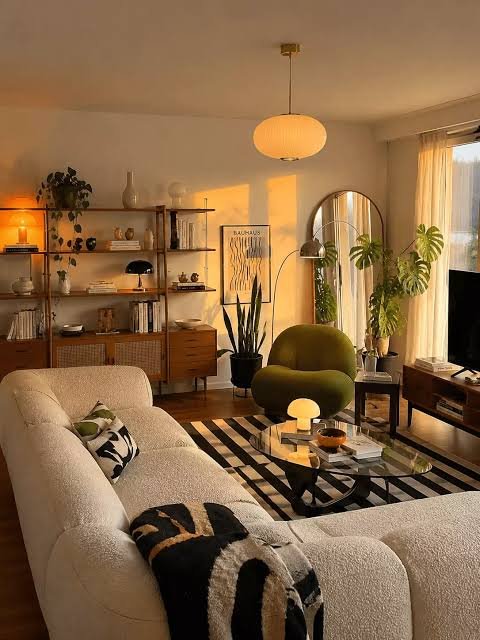
The living room serves many purposes, so it needs flexible, layered lighting. For ambient light, use recessed lights, a central pendant, or a combination of lamps. Add task lighting such as a floor lamp near reading chairs, and table lamps on side tables. Highlight art, bookshelves, and plants with accent lights. Use warm bulbs (2700K) and put each layer on its own dimmer. Aim for at least five light sources at different heights.
Kitchen
The kitchen needs bright, practical, shadow-free light. Provide ambient light with recessed or flush ceiling fixtures, task light with under-cabinet strips over every work surface, and decorative light with pendants over an island or table. Light the sink and the cooktop specifically. Use 3000K–4000K bulbs with a high CRI of 90 or above. Add dimmable accent lights in glass cabinets or toe-kicks for evening ambience.
Dining Room
The dining room benefits from a strong focal fixture over the table, such as a chandelier or pendant, on a dimmer. Add wall sconces or a sideboard lamp for softer ambient light, and candles for atmosphere. Keep the light warm, around 2700K, so that food and faces look inviting.
Bedroom
The bedroom should feel calm and restful. Use soft ambient light from a ceiling fixture or lamps, and provide reading lights on each side of the bed, such as wall-mounted swing-arm lamps or bedside lamps. Add task light for a dressing area or wardrobe. Choose warm bulbs (2700K or warmer) and install dimmers. Consider low-level night lights for safe nighttime movement. Avoid bright, blue-toned light before bed, which can interfere with sleep.
Bathroom
Bathrooms need excellent task lighting around the mirror. Place lights on both sides of the mirror at about face height, or use a well-lit mirror, to avoid shadows. Use moisture-rated fixtures in damp or wet zones, and ambient light from recessed or ceiling fixtures. A high CRI and a neutral to warm white (3000K) help with grooming. Add a dimmable accent light or a night light for gentle evening use.
Home Office
Good lighting reduces eye strain and improves focus. Combine ambient light with a desk lamp placed on the side opposite your writing hand to avoid shadows. Use neutral white light (3500K–4000K), and position screens to avoid glare from windows and lights. Use bias lighting behind the monitor to reduce contrast.
Entryway and Hallways
The entryway makes the first impression, so use a welcoming pendant or flush light, and a lamp or sconce for warmth. In hallways, use evenly spaced ceiling lights, wall sconces, or picture lights, and ensure the staircase is well lit, with lights at the top and bottom, and switches at both ends.
Children’s Rooms
Provide bright, even ambient light for play and homework, a task lamp at the desk, and a soft night light. Choose cool-touch LED bulbs and fixtures that are out of reach. Dimmers allow the room to shift from play to sleep.
Laundry, Pantry, and Utility Spaces
These areas benefit from bright, practical light at 3500K–4000K, with a good CRI to see stains and labels. Motion-sensor lights are convenient in closets and pantries.
Controls: Dimmers, Switches, and Smart Lighting
Controls turn a set of lights into a flexible system.
Dimmers
Dimmers are among the most valuable lighting upgrades. They allow you to change the mood, save energy, and extend bulb life. Install them in living rooms, dining rooms, bedrooms, and anywhere you want flexibility. Check that the dimmer is compatible with LED bulbs, and choose the correct wattage rating.
Switch Placement
Plan switches in convenient places, at the entrance to each room and at both ends of hallways and stairs. Use multi-way switches for rooms with more than one door. Group lights into circuits so that each layer can be controlled independently.
Motion and Occupancy Sensors
Sensors turn lights on when someone enters and off when the room is empty. They are useful in hallways, closets, garages, bathrooms, and outdoor areas for convenience and energy savings.
Smart Lighting
Smart systems allow you to control lights by phone, voice, or schedule, and to create scenes such as “dinner,” “movie,” or “morning.” Tunable white bulbs shift from warm to cool through the day, supporting natural rhythms. Make sure the system is reliable, secure, and compatible with your other devices, and keep a standard wall switch available for guests.
Lighting Scenes
Whether manual or smart, think in scenes. For example, a living room might have a bright “cleaning” scene, a medium “evening” scene with lamps and accent lights, and a low “movie” scene with only the bias lighting behind the TV.
Energy Efficiency and Cost
Good lighting does not need to cost a fortune in electricity. - Switch to LEDs, which can reduce lighting costs by up to 75 percent or more.
- Use dimmers and sensors to reduce wasted energy.
- Use daylight wherever possible.
- Use task lighting instead of lighting the whole room.
- Look for efficiency labels and good lumens-per-watt ratings.
- Clean fixtures and bulbs, since dust reduces output.
- Choose quality products, because cheap LEDs can flicker, shift color, and fail early.
Over time, the savings from LED bulbs far outweigh their initial cost, and the reduced need to change bulbs is a convenience.
Safety Considerations - Never exceed the maximum wattage rating of a fixture.
- Use rated fixtures in wet areas, such as bathrooms, kitchens, and outdoor spaces.
- Hire a qualified electrician for any wiring, installation, or changes to circuits.
- Keep flammable materials away from hot bulbs, lamps, and candles.
- Light stairs and walkways well to prevent falls.
- Use night lights in bedrooms, hallways, and bathrooms for safe night-time movement.
- Secure cords and keep them out of walkways and away from children and pets.
- Dispose of old bulbs responsibly, especially CFLs.
Outdoor Lighting
Outdoor lighting extends your living space, welcomes guests, and improves safety and security.
Entrances and Pathways
Light the front door and house number so visitors can see them easily. Add path lights, step lights, or bollards along walkways. Choose warm, shielded fixtures that direct light downward to avoid glare.
Patios, Decks, and Gardens
Use string lights, lanterns, wall sconces, and soft uplights to create an inviting evening atmosphere. Highlight trees, shrubs, and features with spotlights, and light water features subtly. Solar lights are convenient for gardens, though they are often dimmer.
Security Lighting
Motion-activated floodlights deter intruders and provide convenience. Position them to cover entry points and dark corners, and avoid shining directly into neighbors’ windows.
Reducing Light Pollution
Choose fully shielded, downward-facing fixtures, warm bulbs, and timers or sensors, to protect the night sky, save energy, and be a good neighbor. Avoid over-lighting.
Common Lighting Mistakes
- Relying on a single ceiling light. Layer your lighting with several sources.
- Choosing bulbs that are too cool or too bright for relaxing spaces.
- Mixing different color temperatures in the same room.
- Forgetting task lighting in kitchens, bathrooms, and workspaces.
- Hanging fixtures at the wrong height or choosing the wrong size.
- Skipping dimmers. Fixed brightness limits the mood and flexibility.
- Leaving lighting until the end of a renovation, when wiring is difficult to change.
- Using too few or too many downlights, creating spotty light or a “swiss cheese” ceiling.
- Ignoring glare, especially from exposed bulbs and shiny surfaces.
- Placing lamps at the wrong height so that the shade glares in your eyes.
- Forgetting the dark corners, which make rooms feel smaller.
- Buying decorative fixtures that do not give enough light.
- Overlooking natural light and window treatments.
- Choosing low-quality LEDs that flicker or have poor color.
A Step-by-Step Lighting Plan - List how each room is used, and which activities need focused light.
- Observe the natural light at different times of day.
- Draw a floor plan and mark furniture, windows, and focal points.
- Plan the layers: ambient first, then task, then accent and decorative.
- Decide the number and position of fixtures, and plan outlets and switches before walls are closed.
- Choose color temperature for each room, and keep it consistent.
- Pick the bulbs and check lumens, CRI, and dimmability.
- Select the fixtures, balancing function and style.
- Plan controls, including dimmers, sensors, and smart options.
- Install safely, with a qualified electrician where needed.
- Test and adjust, moving lamps and changing bulbs until it feels right.
- Review in the evening, since a room that looks good in daylight may need adjustments at night.
Frequently Asked Questions
What color temperature is best for a living room?
Warm white, about 2700K to 3000K, creates a cozy, inviting atmosphere. Use dimmers to adjust the mood.
How many lumens do I need in a room?
As a rough guide, living rooms and bedrooms need about 10 to 20 lumens per square foot, kitchens about 30 to 40, and workspaces about 40 to 50. Adjust for wall color and personal preference.
Are LED bulbs worth it?
Yes. They use far less energy, last much longer, and are available in every color temperature and shape, so the savings are significant over time.
What is the difference between warm white and daylight bulbs?
Warm white (2700K–3000K) has a yellowish, cozy glow. Daylight bulbs (5000K–6500K) look bluish-white and are bright and crisp. Warm white suits living areas, and daylight suits task areas.
How high should I hang a pendant light?
Over a table or kitchen counter, hang it about 30 to 36 inches above the surface. In an entryway or a place where people walk, keep the bottom at least 7 feet above the floor.
Do I need dimmers?
Dimmers are not essential, but they are one of the most useful upgrades, allowing the same room to serve different moods and activities. Make sure the bulbs and the dimmer are compatible.
How can I make a dark room brighter?
Use light paint colors, mirrors, sheer curtains, and layered lighting with lamps, wall lights, and bright bulbs. Keep windows clear and avoid blocking light with furniture.
Final Thoughts
Lighting is the invisible architecture of a home. It shapes how each space looks and feels, how we use it, and how we feel while we are there. By thinking in layers, choosing the right color temperature and brightness, making the most of daylight, and adding controls for flexibility, you can transform any room without moving a single piece of furniture.
Plan your lighting early, test it in the evening, and adjust until each room feels right. A few well-chosen lamps, a dimmer or two, and warm, high-quality bulbs often make a bigger difference than a major renovation.
At Homely Ideas, we hope this guide helps you light your home beautifully and efficiently. Explore our other guides for ideas on every room and style.