Home Lighting Design Guide
Introduction
: Why Lighting Makes or Breaks a Home
Lighting is the most underrated element of home design. People spend weeks choosing sofas, tiles and paint, then fit a single bulb in the middle of the ceiling and wonder why the room feels flat. In reality, light decides how every colour, material and piece of furniture will look. A beautiful room under poor light looks dull, and a simple room under good light looks warm and inviting.
Good lighting does three jobs at once. It lets you see clearly and safely, so you can cook, read, work and walk through the house without strain. It shapes mood, because soft warm light relaxes us while bright cool light keeps us alert. And it highlights the architecture and decor you care about, such as a textured wall, a favourite painting or a corner of plants.
Many homes in Pakistan and across South Asia rely on one central ceiling light or a bare tube light in each room. This gives enough brightness, but it creates harsh shadows, glare and a flat atmosphere. Adding a few lamps, wall lights or strip lights at different heights can change a room completely, often for a modest cost.
Lighting also affects comfort and health. Poor or glaring light can cause eye strain and headaches, particularly when reading or working on a screen. Light that is too bright late at night can make it harder to wind down. Careful planning helps protect your eyes and supports healthy daily rhythms.
This guide covers the full process. You will learn the key technical terms in simple language, the three layers of lighting every room needs, and the main types of fixtures. You will find lighting plans for each room, advice on combining daylight with electric light, and a section on smart lighting. You will also see how to save energy with LEDs and plan for power cuts, how to light outdoor spaces, and a step-by-step planning method with a budget guide, common mistakes and a short FAQ.
The golden rule to keep in mind is simple: layer your light, give each layer its own switch, and choose warm light for relaxing and brighter light for working. With that foundation, even a modest home can feel carefully designed.
Lighting Basics in Plain Language
A few technical terms appear on every light bulb box. Once you understand them, buying lights becomes much easier.
Lumens: how bright is it?
Lumens measure the amount of light a bulb produces. Watts only tell you how much electricity it uses, which was a useful guide for old incandescent bulbs but not for LEDs. A 9 watt LED can give as much light as a 60 watt incandescent bulb, around 800 lumens.
Colour temperature: warm or cool?
Colour temperature is measured in Kelvin (K). Lower numbers give warm, yellowish light and higher numbers give cool, bluish light.
Kelvin
Name
Feel
Best for
2200 to 2700 K
Extra warm
Candle-like, very cosy
Bedside lamps, dining mood lighting
2700 to 3000 K
Warm white
Cosy, relaxing
Living rooms, bedrooms
3500 to 4000 K
Neutral white
Clean, balanced
Kitchens, bathrooms, offices
5000 to 6500 K
Daylight, cool white
Bright, sharp, alert
Garages, workshops, some task areas
For most living spaces, warm white is the most comfortable. Very cool 6500 K bulbs often feel harsh and clinical inside the home.
CRI: how true are the colours?
Colour Rendering Index (CRI) is a score up to 100 showing how accurately a light shows colours. Aim for CRI 80 or higher for general use, and 90 or higher in kitchens, dressing areas, bathrooms and anywhere colour accuracy matters, such as art or make-up. Low CRI makes food, skin and fabrics look dull.
Beam angle
Beam angle tells you how wide the light spreads. A narrow beam of about 15 to 30 degrees creates a focused spot for highlighting art or a feature. A wide beam of 60 degrees or more lights a broad area evenly. Choose narrow beams for accents and wide beams for general light.
How much light does a room need?
A simple rule of thumb is to plan for roughly the following amount of light per square metre of floor area. These are guidelines, not strict rules.
Room
Approximate lumens per sq m
Living room
150 to 200
Bedroom
100 to 150
Kitchen
300 to 400
Bathroom
200 to 300
Study or office
300 to 500
Hallway
100 to 150
For example, a 4 by 5 metre living room has 20 square metres of floor. At 150 to 200 lumens per square metre, you need about 3,000 to 4,000 lumens in total, which you should divide among several fixtures instead of one bulb.
Other labels worth knowing
- Dimmable: only dimmable bulbs work with dimmers, so check the box.
- IP rating: shows protection against dust and water. Use IP44 or higher in bathrooms and IP65 or higher outdoors.
- Flicker-free: cheap LEDs can flicker, which causes eye strain. Look for good-quality, flicker-free drivers.
- Lifespan: quality LEDs typically last 15,000 to 25,000 hours.
The Three Layers of Lighting
Professional designers never rely on a single light source. They build a room from three layers, each with its own purpose, and then control them separately.
Layer 1: Ambient lighting
Ambient light is the general, overall illumination of a room. It lets you see and move around comfortably. Typical sources include ceiling lights, recessed spotlights, panel lights, cove lighting and large pendants. Good ambient light is soft and even, without harsh glare or dark corners. It should be bright enough for daily use and dimmable so that it can be turned down in the evening.
Layer 2: Task lighting
Task light is focused light for a specific activity. It sits close to the job and puts brightness where you need it. Examples include: - Under-cabinet strip lights above kitchen counters
- A reading lamp beside the sofa or bed
- A desk lamp in the study
- Lights beside or above a bathroom mirror
- A bright light over the dining table or a work table
Task light should be bright, glare-free and positioned so that your own shadow does not fall on your work. For reading, place the lamp slightly behind and to the side of your shoulder.
Layer 3: Accent lighting
Accent light adds drama, depth and focus. It highlights art, shelves, plants, textured walls, architectural features and favourite objects. Common sources include small spotlights, picture lights, track lights, LED strips behind a TV or under shelves, and uplights behind plants. A good rule is that accent light should be about three times brighter than the ambient light on the object you are highlighting.
How the layers work together
Layer
Purpose
Typical fixtures
Warmth
Ambient
General light
Ceiling lights, recessed spots, cove lights
Warm to neutral
Task
Specific jobs
Desk lamps, under-cabinet strips, mirror lights
Neutral, high CRI
Accent
Mood and focus
Spotlights, picture lights, LED strips
Warm
Give each layer its own switch
The real power of layering comes from control. If every light is on one switch, you gain nothing. Plan separate circuits or switches for each layer, and add dimmers where you can. In the evening you can turn off the main ceiling light and use only lamps and accents for a relaxed mood. During a family meal, you might use the dining pendant and soft wall lights. For cleaning or work, you can switch on everything.
Aim for light at different heights
A room lit only from above feels flat. Include light at ceiling level, eye level and low level: for example, recessed lights above, wall lights at head height and table lamps near the floor. This creates gentle, layered light and softens shadows on faces.
Types of Light Fixtures and Where to Use Them
Choosing the right fixture is as important as choosing the right bulb. Here are the main types and what each does best.
Ceiling-mounted and flush lights
These sit close to the ceiling and spread light across the room. They suit low ceilings, hallways and bedrooms. Choose diffused covers to avoid glare and use dimmable LED versions. A single flush light is a decent start, but it should be supported by lamps and accents.
Recessed downlights (spotlights)
Recessed lights are set into a false ceiling and give clean, modern lighting. Because they are so common in homes with false ceilings, many people overuse them. Space them evenly, usually 1 to 1.5 metres apart, avoid placing them directly above seating where they can glare, and use warm white, anti-glare versions. Use them to wash walls, light corridors and highlight features, not as the only source of light.
Pendant lights and chandeliers
Pendants hang from the ceiling and work as both light and decoration. Use them above dining tables, kitchen islands, stair voids and entrances. Hang a dining pendant about 75 to 85 cm above the table surface so that it lights the table without blocking views. Chandeliers suit high ceilings and formal spaces, and a statement fixture can anchor a room. Always combine decorative fixtures with other layers.
Wall lights (sconces)
Wall lights add soft light at eye level and are ideal beside beds, mirrors, staircases and along hallways. Up-and-down sconces wash the wall with soft light, while directional ones suit reading. Bedside wall lights free up space on small tables.
Table lamps and floor lamps
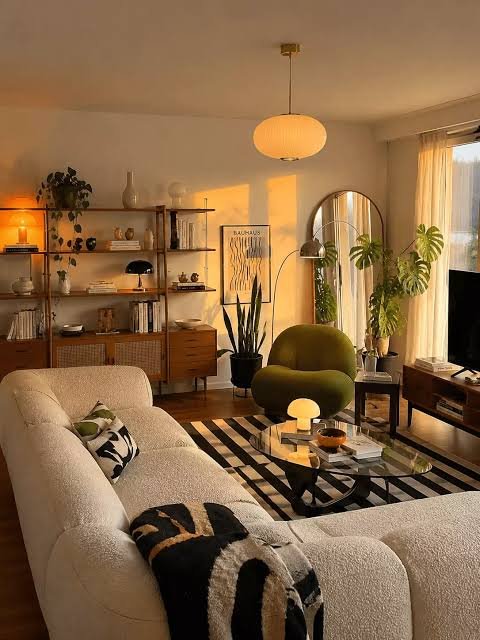
Portable lamps are the easiest way to add warm layered light without electrical work. Table lamps suit side tables, consoles and bedside tables. Floor lamps work in corners, behind sofas and beside armchairs. Use a shade that diffuses light and choose a warm bulb. Arc floor lamps can act as reading lights above a sofa without needing a ceiling point.
LED strip lights and cove lighting
LED strips hide in coves, behind false ceilings, under shelves, beneath kitchen cabinets and behind TVs or mirrors. They give soft, indirect light with no visible source. In a false ceiling, a cove strip is a very popular way to produce ambient light. Choose good-quality strips with high CRI and a consistent colour temperature, and use proper diffusers or channels to avoid dotted-looking light.
Track and spot lights
Track lights can be rotated to point at art or walls, and they suit galleries, living rooms and shops. They are flexible and good for changing displays.
Picture and display lights
Small, focused lights above or below art and shelves add depth and make collections feel special. Use a narrow beam and a warm, high-CRI bulb.
Under-cabinet and task lights
In kitchens and study areas, slim LED bars or strips mounted under cabinets or shelves give even task light and remove shadows from counters.
Fixture quick guide
Fixture
Main role
Best locations
Watch out for
Flush ceiling light
Ambient
Bedrooms, hallways
Flat light if used alone
Recessed downlight
Ambient and accent
False ceilings, kitchens, corridors
Glare, overuse
Pendant
Decorative, task
Dining, island, entrance
Wrong height
Wall light
Ambient, accent
Bedsides, hallways, mirrors
Wiring planning
Table lamp
Ambient, task
Side tables, desks
Shade and bulb choice
Floor lamp
Ambient, task
Corners, sofas
Cable placement
LED strip
Ambient, accent
Coves, under shelves
Quality and diffusion
Track light
Accent
Walls, art
Glare if misaimed
Room-by-Room Lighting Plans
Each room needs its own combination of layers. Use these plans as a starting point and adjust to your room size, ceiling height and furniture.
Living room
The living room serves many purposes, so flexibility is the key. Plan ambient light from recessed spots, a ceiling light or cove strips, all on a dimmer. Add table or floor lamps beside the sofa for reading and for a warm evening glow. Use accent lighting on art, shelves or a feature wall, and consider LED strips behind the TV to reduce eye strain. Choose warm white at 2700 to 3000 K, and group the circuits so that you can create three scenes: bright for cleaning and guests, medium for family time and low for movie nights.
Bedroom
The bedroom should be calm and gentle. Use soft ambient light from a ceiling fixture or cove with a dimmer, and keep colour temperature at 2700 K or lower for the evening. Place bedside lamps or wall lights on both sides of the bed, with separate switches so one person can read while the other sleeps. Add a low, soft night light on the path to the bathroom to avoid bright lights at night. A wardrobe light that comes on when the door opens makes dressing easier. Avoid downlights directly above the bed, which can shine in your eyes when you lie down.
Kitchen
Kitchens need bright, even light for safe food preparation. Use neutral white at 3500 to 4000 K with high CRI so food looks natural. Combine ambient ceiling lights with under-cabinet task lights on every counter, so that you do not cook in your own shadow. Add a pendant over an island or breakfast table for style, and light inside tall cabinets and drawers if you have a modern layout. Choose easy-clean fixtures that resist grease and moisture.
Dining area
Dining light should be warm and flattering. Hang a pendant or chandelier above the table, with a dimmer, and add soft wall lights or a sideboard lamp for depth. A warm light at about 2700 K makes people and food look appealing. Make sure that the light does not glare into the eyes of those seated.
Bathroom
Bathrooms need good, shadow-free light around the mirror. Place lights on both sides of the mirror at face height, or use an illuminated mirror, rather than a single light above, which casts shadows under the eyes and chin. Use neutral white with CRI 90 or higher, and choose fixtures with a suitable IP rating (IP44 or higher near water, higher inside shower zones). A dimmable warm night light helps for night visits.
Home office or study
A workspace needs bright, glare-free light of around 300 to 500 lux at the desk. Use neutral white at about 4000 K, put the desk lamp on the opposite side of your writing hand to avoid shadows, and position the screen so that windows and lights do not reflect in it. Add soft ambient light behind or around the screen to reduce contrast and eye strain.
Hallway and staircase
Hallways are passages, so they need even, soft light and safety. Use ceiling or wall lights spaced evenly, and add low-level step lights or strip lights on stairs for safety at night. Motion sensors are very useful here: they switch lights on when needed and off when you leave.
Children’s room
Children need bright light for play and study, and soft light for sleep. Use a dimmable ambient light, a desk lamp for homework and a warm night light. Avoid exposed bulbs and fixtures within reach, and choose rounded, cool-touch LED lights. Keep cords out of reach and secure any wall-mounted fixtures.
Prayer room or quiet room
Soft, warm and indirect light supports stillness. Use a dimmable ceiling or wall light, avoid harsh spots and keep the lighting quiet and even.
Entrance and foyer
The entrance should welcome people and feel safe. A pendant or soft ceiling light, a lamp on a console and a light near the door for finding keys make it practical. Outside, use a sensor light for security and convenience.
Combining Natural and Artificial Light
Daylight is free and flattering, so good lighting design begins with windows and ends with electric light that fills the gaps.
Maximise daylight - Keep windows clear of heavy furniture and thick curtains.
- Use sheer or light-filtering curtains and blinds so that you control glare without blocking light.
- Paint walls and ceilings in light, reflective colours, and use mirrors opposite windows to bounce light deeper into the room.
- Choose glossy or light floors to reflect more light upward.
- Trim trees or shrubs outside that shade windows.
Control glare and heat
In hot, sunny climates, strong sunshine can heat rooms and cause glare on screens and TVs. Use blinds, sheer curtains, window films or external shading, such as awnings and louvres, to block direct summer sun while keeping daylight. East- and west-facing windows often need the most protection.
Plan for the transition to evening
As daylight fades, a room that looked bright can suddenly feel dark. Switch on ambient light gradually, starting with lamps and accent lights rather than a very bright ceiling light, to keep a smooth transition. Use warm light in the evening to match the natural sunset glow and to support winding down.
Daylight sensors
Some smart systems dim electric lights automatically when daylight is strong and brighten them as it fades. This saves energy and keeps the room evenly lit. They are especially helpful in offices and open rooms with large windows.
Skylights and light wells
If your home has dark inner rooms, consider a skylight, a light well or a glass partition to let daylight in. Even a small opening, combined with light colours and mirrors, can transform a dark corridor or staircase.
Smart Lighting
Smart lighting lets you control brightness, colour and timing from a phone, a voice assistant or a wall panel. It is not essential, but it can make a well-planned home more comfortable and efficient.
What smart lighting can do - Dimming and colour control: change brightness and warmth from your phone, or from a wall switch.
- Scenes: save presets such as Morning, Dinner, Movie and Night, and switch between them with one tap.
- Schedules: lights turn on at dusk, dim in the evening and switch off at bedtime.
- Voice control: use a smart speaker to control lights hands-free.
- Motion and presence sensors: lights turn on when someone enters a hallway or bathroom and switch off after they leave.
- Away mode: random schedules make the house look occupied when you travel.
Ways to go smart
Option
How it works
Cost level
Good for
Smart bulbs
Replace ordinary bulbs with Wi-Fi or Zigbee bulbs
Low to medium
Renters, single lamps, trying it out
Smart switches or relays
Fit behind existing switches to control any light
Medium
Whole-home control without replacing fittings
Smart dimmer modules
Add dimming and scenes to compatible LED lights
Medium
Living rooms and bedrooms
Full home automation
Central controller and wired system
High
New builds and big renovations
Practical tips
- Start with one or two rooms. Try the living room and bedroom first and see if you use the features.
- Keep wall switches working. Choose systems that still work with a physical switch, because guests and family will not always use the app.
- Check compatibility. Make sure bulbs, dimmers and controllers use the same standard, such as Wi-Fi, Zigbee, Matter or Bluetooth, and that LEDs are dimmable.
- Think about the internet. Choose a system that still works locally when the internet is down, which matters in places with unstable connections.
- Mind security. Use strong passwords, update firmware and buy from known brands.
Setting up scenes
A few simple scenes cover most needs. “Morning” might turn on bright neutral light in the kitchen and hallway. “Evening” dims the living room to 40 percent warm light and turns on lamps. “Night” turns off everything except a low path light. “Away” turns lights on and off at random times. Name the scenes simply so that everyone can use them.
Energy-Saving Lighting
With electricity costs rising in many countries, efficient lighting saves real money. It also matters in homes that face load shedding or unstable supply, where every watt on a backup battery counts.
Switch to LED
LEDs use a fraction of the electricity of old incandescent bulbs and a good deal less than most fluorescent tubes, while lasting many times longer. A rough comparison for about 800 lumens, the light of a traditional 60 watt bulb:
Bulb type
Typical power for 800 lumens
Typical lifespan
Incandescent
About 60 W
About 1,000 hours
Halogen
About 40 to 45 W
About 2,000 hours
CFL (energy saver)
About 13 to 15 W
About 8,000 hours
LED
About 8 to 10 W
About 15,000 to 25,000 hours
The figures are typical values and vary by brand. Prices differ by market and change often, so compare the price per lumen and the warranty rather than only the price on the box.
Calculate your savings
A simple formula helps you estimate the saving: multiply the power difference in watts by the hours used per day, by 30 days, and divide by 1,000 to get units (kWh) per month. For example, replacing ten 60 W bulbs with 9 W LEDs used five hours a day saves about 51 watts times 10 bulbs times 5 hours times 30 days, divided by 1,000, which is roughly 76 units per month. Multiply the result by your tariff to see the money saved.
Habits and design choices that help
- Use dimmers, because lights at 50 percent use noticeably less power.
- Install motion sensors in corridors, bathrooms and storerooms.
- Rely on daylight during the day, and keep windows clean and uncluttered.
- Choose task lighting instead of lighting a whole room for one activity.
- Use light colours on walls and ceilings so that fewer lights are needed.
- Turn off lights in empty rooms, or use timers.
Planning for power cuts and load shedding
If your area has regular outages, plan lighting that keeps working when the grid goes down.
- Use a small, separate backup circuit for essential lights such as the hallway, kitchen, bedroom and one living area, so that you do not drain the battery on the whole house.
- Choose LEDs on a UPS or inverter, because their low power draw means a battery lasts much longer.
- Keep rechargeable emergency lights or lanterns in visible places, such as the hallway and kitchen.
- Consider solar: a small solar panel with a battery can power LED lights, and solar garden lights can light paths without wiring.
- Add motion-sensor night lights that run on batteries for safe movement at night.
Check compatibility with an electrician before connecting lights to an inverter or UPS, especially for dimmers and drivers that may not work well with some backup systems.
Outdoor and Decorative Lighting
Outdoor lighting extends the usable life of your home into the evening and improves safety and security.
Entrance, gate and facade
Light the main gate and entrance door with a warm, welcoming fixture, and use wall lights on both sides of the door or a single pendant on a covered porch. Facade lighting, such as up-lights on textured walls or columns, adds character at night. Aim lights carefully so that they do not shine into neighbours’ windows or the eyes of visitors.
Garden, lawn and terrace
Light paths with low bollards or step lights, trees with up-lights and seating areas with soft lanterns or string lights. Use warm white at 2700 to 3000 K, which feels natural around plants. Avoid over-lighting, because dark areas allow the eye to rest and make lit areas more dramatic.
Balcony and rooftop
String lights, wall lanterns and LED strips under railings or benches give a cosy atmosphere. Choose IP65 or higher fixtures because they are exposed to rain and dust.
Security lighting
Motion-activated floodlights at the gate and back door deter intruders and help you see who is outside. Place them high, aimed downward, and use warm or neutral white to avoid harsh glare.
Decorative and festive lighting
Fairy lights, lanterns and fixtures with decorative shades work well for occasions such as Eid, Ramadan, weddings and Diwali. Use them seasonally and keep the permanent lighting simple so that decorative lights can stand out. Use certified, weather-rated cables and avoid overloading sockets, as festive lighting often causes electrical overloads.
Solar options
Solar path lights and garden lights need no wiring and keep working during power cuts. Choose models with good panels and a battery that lasts the whole night, and place the panels where they get direct sunshine.
Planning Steps, Mistakes and Budget
A seven-step lighting plan - Draw the room. Sketch the floor plan with doors, windows, furniture and key activities.
- List the activities. Note where you cook, read, work, relax or entertain.
- Choose the layers. For each area, decide what ambient, task and accent light it needs.
- Decide the controls. Group lights into circuits and add dimmers where mood matters.
- Choose fixtures and bulbs. Match colour temperature, CRI and beam angle to the use.
- Plan the wiring early. Wall lights, cove lights and concealed strips need to be planned before plastering and false ceiling work.
- Test and adjust. Live with the lighting for a few evenings and adjust bulbs, positions and dimmer levels.
Common mistakes
- Relying on one ceiling light. Always add lamps or wall lights.
- Choosing a bulb that is too cool. Very white bulbs feel harsh at home. Use warm white in living spaces.
- Overusing recessed spotlights. Too many create a spotted ceiling and glare.
- Mixing colour temperatures. Different warmths in one room look uneven.
- Forgetting dimmers. Without them, one brightness has to suit every mood.
- Ignoring glare. Bare bulbs and badly placed spots hurt the eyes.
- Hanging pendants at the wrong height. Too low blocks views and too high gives poor task light.
- Planning too late. Adding wiring after the walls are finished is costly.
- Buying cheap LEDs. Poor quality can flicker, fade and fail early.
Setting a lighting budget
As a general guide, many designers suggest setting aside a modest share of a renovation or fit-out budget for lighting, and spending more on the rooms where you spend the most time. Because prices change by market and brand, use the comparison below as a planning order rather than exact costs.
Priority
Where to spend more
Where to save
High
Kitchen task lights, bathroom mirror lights, reading lights, dimmers
Plain bedroom ceiling lights
Medium
Dining pendant, living room lamps, cove strips
Hallway fixtures, store rooms
Low
Decorative accents, festive lights
Rarely used spaces
Tips to stretch the budget - Start with good bulbs: warm, high-CRI, dimmable LEDs make even simple fixtures look better.
- Add lamps instead of rewiring, since portable lamps are cheap and flexible.
- Buy one statement fixture for the dining or living area and keep the others simple.
- Phase the work: do essential wiring and ceilings first and add decorative and smart elements later.
- Compare brands for warranty, and keep receipts for replacements.
Frequently Asked Questions
What colour temperature is best for a living room?
Warm white, around 2700 to 3000 K, is the most comfortable for living rooms and bedrooms. Use neutral white, around 3500 to 4000 K, in kitchens, bathrooms and study areas.
How many recessed lights do I need in a room?
As a rough guide, space them about 1 to 1.5 metres apart and aim for the total lumens suggested for the room, instead of choosing a fixed number. Fewer, better-placed lights with lamps and cove light usually look better than a ceiling full of spots.
Are LED strip lights safe and durable?
Quality strips from reputable brands, with proper power supplies and good heat dissipation, are safe and last for years. Avoid very cheap strips, which can fade, flicker or overheat.
Do I need smart lighting?
No. Good layered lighting with dimmers is more important. Smart control is a convenient extra, especially for scenes, schedules and sensors.
How do I choose between warm and cool light?
Use warm light where you want to relax and cool-neutral light where you need to concentrate or see detail. Keep the same colour temperature within one room.
How can I reduce glare?
Use diffused covers, shades and recessed fixtures with deep baffles, avoid bare bulbs at eye level, and place lights so they do not reflect in screens or glossy surfaces.
Can I use LED bulbs on a dimmer?
Yes, but only if both the LED bulb and the dimmer are made for dimming and are compatible. Otherwise, you may see flicker or buzzing.
Conclusion
Great lighting is built in layers: ambient light for general use, task light for jobs and accent light for mood. Choose warm, high-quality LEDs, give each layer its own control, bring in daylight wherever you can and plan the wiring before construction. Add smart features and energy-saving habits where they suit your lifestyle, and prepare for power cuts if they are part of daily life. With a thoughtful plan, even a simple home can feel comfortable, beautiful and personal every hour of the day.